·
12 min read
Seraph Peak · Software & Sanity
If you have tried to build something on the web in the last few years, you have felt it: the work is not only writing code anymore.
It is choosing a framework. Then choosing how you deploy it. Then choosing a database, an auth provider, a queue, a cache, an email service, an analytics tool, an error tracker, and a billing stack. Then choosing how you monitor it. Then choosing how you secure it. Then choosing how you keep it all updated while the original roadmap keeps moving.
None of these choices are inherently bad. In isolation, each tool can be great. The problem is what happens when you put twenty “great” tools together, each with its own pricing model, its own dashboard, its own failure modes, and its own assumptions about how your system should work.
That is where most projects quietly bleed time and money. Not because the idea was weak, but because the foundation was never set up to stay calm as the project grows.
Seraph Peak exists to fix that.
If you want to talk through what you are building, email us at [email protected].

The real problem is not a lack of tools
When people say, “There are too many choices,” they often mean, “I do not know which choice is safe.”
You can ship an MVP with almost anything. You can also dig a hole with almost anything. The danger is that early decisions tend to become permanent, especially when the codebase starts to accumulate features, customers, and integration points.
Tool sprawl creates three slow-moving problems:
First, you lose clarity. When a bug happens, you do not know which system is responsible. Logs are in one place, metrics in another, billing in another, secrets in another, and deployments somewhere else. Your brain becomes the integration layer.
Second, you lose control of cost. A “free tier” here and a “per seat” there feels harmless until usage grows. Then the bill arrives with line items that no one remembers agreeing to. Worse, the most expensive services tend to be the ones you cannot easily remove because they are now coupled to the core of your application.
Third, you lose maintainability. Every new tool adds configuration surface area. Every configuration knob adds ways to drift. Drift is where “works on my machine” evolves into “we are afraid to touch this.”
The punchline is that the project still ships, but it ships slower each month. It becomes fragile. Eventually, the team stops making improvements to the foundation because improvements feel risky, and the product carries that risk forward forever.
The AI era did not replace engineering, it raised the bar for intention
AI can write code quickly. It can draft components, endpoints, and scripts in minutes. Used well, it makes small teams feel large.
Used without guardrails, it produces a codebase that is hard to reason about. Not because the code is always wrong, but because it is often inconsistent. Naming shifts. Patterns change mid-file. Types are partially applied. Tests are missing or superficial. The app works, but only as long as nobody asks it to change.
This is the part people do not like to hear: AI works best inside a well-defined, properly set up framework. The “framework” is not just your web framework. It is the whole environment that tells both humans and AI what “good” looks like in this project.
When your repository has a clear architecture, strict typing, predictable patterns, a deployment pipeline, and meaningful test coverage, AI becomes an amplifier. It can move fast without making the codebase feel like it was assembled from unrelated snippets.
When those things are missing, AI becomes a multiplier for entropy. It will produce more code than your system can safely absorb.
Seraph Peak treats this as the core design problem of modern software: how do we make a codebase that can accept velocity without losing its shape?
What Seraph Peak does
Seraph Peak is a consultancy focused on building cost-effective web software. Sometimes that is a simple marketing site with a blog. Sometimes it is an application with real workflows, data, permissions, and integrations. Sometimes it is taking an existing system that has grown messy and making it sane again.
AI can help you move faster. A solid foundation decides whether that speed turns into progress or tech-debt.
We are small by design, but we are not limited to one shape of work. We have a network of trusted product, engineering, design, QA, and SEO resources who can plug into a project when it needs extra hands or a specialized skillset. That means you do not have to choose between a tiny team that cannot scale and a big agency machine that brings complexity of its own.
If you are considering a new build or a refactor, send a note to [email protected] and we will reply with a few focused questions.
Our work usually starts in one of two places.
Either you have a new idea you want to bring to life, and you need a foundation that will not collapse when the idea succeeds.
Or you already have an application, and you can feel the weight of its current shape. Development is slower than it should be, deployments feel stressful, costs are creeping, and there is no obvious path to improvement that does not involve a risky rewrite.
In both cases, our approach is the same: reduce the number of moving parts, strengthen the parts that remain, and make sure the result can be owned with confidence.
That looks like a few concrete services.
We help you determine what tools and functionality are actually needed to meet the spec, nothing more and nothing less. This sounds obvious, but it is where most projects go off the rails. People adopt entire platforms to solve one narrow need, or they accept “default” architectures that are optimized for someone else.
We build the platform-agnostic code foundation and automated deployment process with full type safety and meaningful code coverage. Not because tests are fashionable, but because they are the cheapest way to preserve your ability to change the software later. Type safety and tests are how you keep speed without gambling on every release.
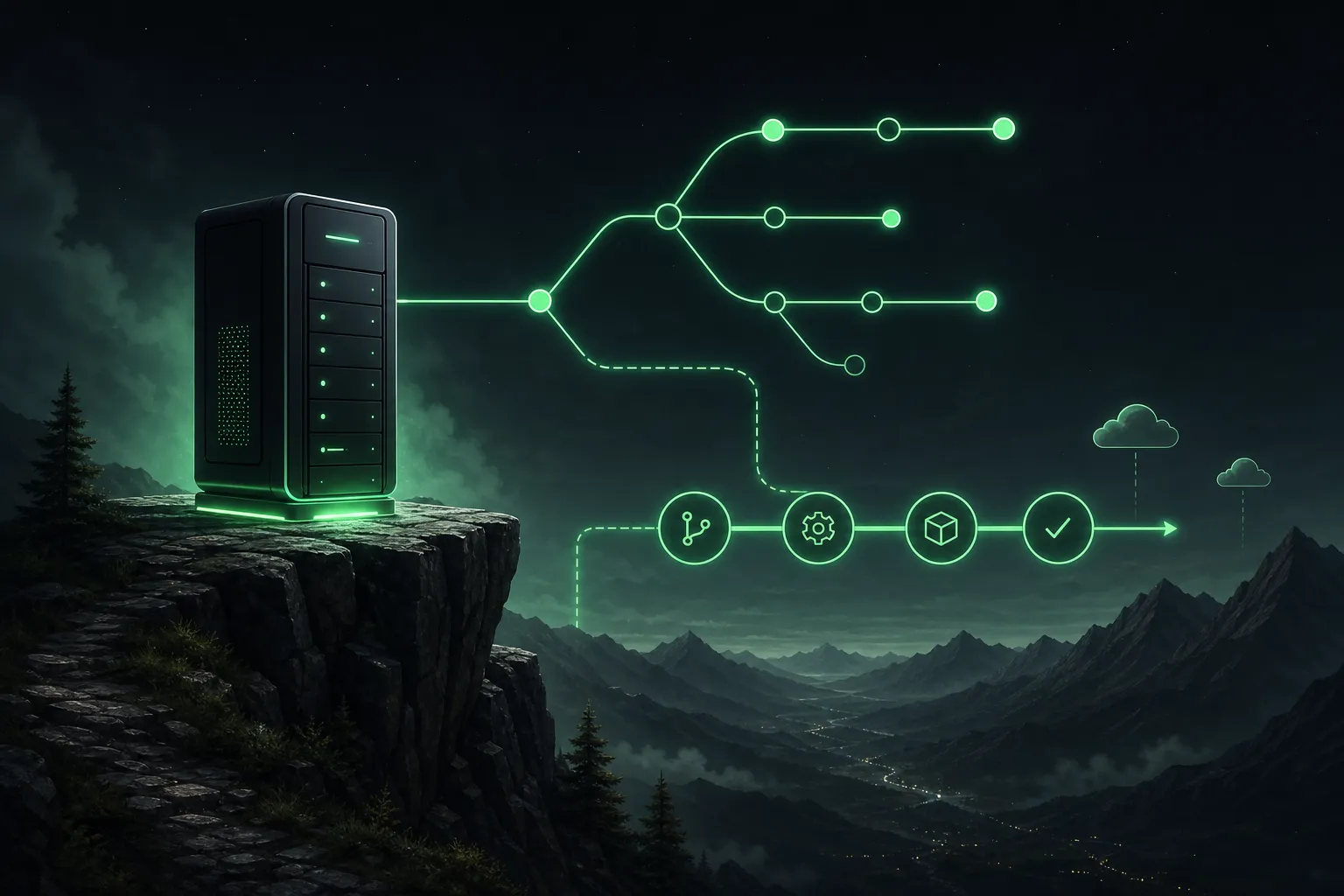
We offer a fixed-cost option where we set up your application and hand over a VPS and a git repository with up to two years of zero recurring costs. This is not a magic trick. It is a preference for simple infrastructure when it fits the problem. Many teams do not need a complex managed stack to get real value, especially early on.
We offer maintenance and feature build-out packages as an option. Some teams want a clean hand-off; others want an ongoing partner who can keep shipping while the system stays healthy. Both are reasonable, and we can support either.
We also handle the less glamorous parts of running a business online: corporate proxies, mail servers, WordPress or other CMS setups, and support integrations. If it touches your ability to operate, it matters. If it matters, it should be stable and understandable.
Why this matters right now
The internet has always been noisy, but the last few years have created a specific kind of noise: the kind that looks like progress.
Every week there is a new framework that promises better performance. A new cloud service that promises easier scaling. A new AI tool that promises to eliminate work. Each promise has a kernel of truth, which is what makes it tempting.
The cost is that the surface area of “the right way to build” keeps expanding. The average founder or small team cannot evaluate all options, and most do not have the time to become experts in infrastructure, security, and operations.
So projects become a patchwork. That patchwork can run for a while, but it becomes expensive in the ways that matter: attention, confidence, and momentum.
Here is a simple way to think about the trade-off. It is not that managed platforms are “bad.” It is that each one adds a new place where your project can get locked in, drift, or become expensive.
| Decision | What you gain | What it can cost later |
|---|---|---|
| Add a new managed service | Less work this week, a fast integration | Another dashboard, pricing surprises, harder migrations |
| Adopt a new framework because it is hot | A short-term boost in excitement | Hiring friction, churn in patterns, ecosystem gaps |
| Outsource architecture to defaults | Speed and fewer decisions upfront | A system shaped for someone else, hard to unwind |
| Add AI without conventions | More code produced per day | Inconsistency, weak tests, and fragile changes |
Seraph Peak is built around a different belief: the goal is not to use the newest tools. The goal is to deliver value reliably, with a system you can understand and afford.
There is a kind of freedom that comes from a simple deployment you control. From a codebase that has a clear shape. From a pipeline that runs the same way every time. From knowing that you can change direction without needing to rewrite everything.
That freedom is what lets you focus on your product instead of your stack.
Our bias: boring where it counts, modern where it helps
“Boring” does not mean outdated. It means predictable.
We like modern tooling when it reduces complexity. Strong typing is not boring, it is a seatbelt. Automated deployments are not boring, they are a way to make releases feel routine. Static sites and content collections are not boring, they are often the simplest possible answer for marketing pages and blogs.
We do not like complexity that exists to impress. We do not like architecture diagrams that are more elaborate than the product. We do not like solutions that require a specialist to keep the lights on.
When a problem genuinely needs a managed service, we will use it. When it does not, we will not pretend it does.
This is also why we care about documentation, conventions, and code health. Those are not extras. They are the difference between a project you can extend and a project you fear.
How we work (in plain terms)
We start by making the decision space smaller.
What are you trying to accomplish in the next 30, 60, and 90 days? What does “done” look like? What needs to exist for the project to be valuable, and what is optional? What kinds of failures are unacceptable, and what can be rough early on?
Then we choose an implementation that matches the real requirements, not the imagined ones.
If you need a static marketing site and a blog, we build that with a clean content structure, fast pages, and a design system that does not get in the way. If you need an application, we define the architecture early: how data flows, where boundaries are, how deployments happen, and how you will test changes.
When it helps, we bring in the right specialists from our network. That might be a designer to tighten UX and visual language, an SEO partner to make sure your content and technical setup are aligned, or additional engineers to accelerate a milestone without compromising quality. The goal is to keep the team as small as possible while still giving the project what it needs.
The goal is not to assemble the biggest team. It is to have a proper plan up front, then bring the right skills in at the right time and execute with maximum effect, for both short and long-term success.
We also plan for the hand-off. Even if we keep working with you long-term, the system should never feel like it is “ours.” It should be your repository, your infrastructure, and your ability to operate.
We aim for a posture where adding features feels like building on a foundation, not pulling a thread on a sweater.
Zero recurring costs, when it makes sense
There is a lot of talk in tech about “scaling.” Scaling is real, but it is not the first problem most businesses have.
The first problem is finding a real customer need, building the smallest thing that solves it, and iterating quickly without burning cash.
For many early-stage products, a well-configured VPS is enough. It is simple to understand, simple to budget, and simple to move away from if you later need something more advanced. It is also a good way to avoid paying a tax for complexity you are not yet using.
Our fixed-cost option is built around this reality. If your project fits the profile, we can set you up with infrastructure you own, predictable costs, and a deployment process that keeps the whole system reproducible.
If your project does not fit, we will say so. The goal is not to force every problem into the same box. The goal is to give you an honest foundation.
A note on taste and restraint
There is a common failure mode in engineering: shipping a system that is technically impressive but operationally fragile.
The counterbalance is restraint. Restraint is the choice to keep the system small enough that it stays legible. It is the choice to use a single good pattern instead of three clever ones. It is the choice to say no to a tool that would add a dashboard and a bill unless it truly buys you something.
Restraint is also the choice to keep content human.
If this post reads like someone who has built and maintained software is talking to you, that is intentional. We are not trying to sell you on a buzzword. We are trying to describe a way of working that helps projects survive contact with reality.
If you are building something, we can help
If you have a new idea and you want to move quickly without building on sand, we can help you set up the foundation and ship a first version you can iterate on.
If you have an existing application and it feels harder to change than it should, we can help you refactor it into a shape that is easier to maintain and cheaper to operate.
And if you are not sure what you need yet, that is fine too. Most good projects start as a rough idea with a few constraints and a deadline.
Seraph Peak exists to turn that into software you can live with.
Email us at [email protected] and let’s get your idea moving forward.